
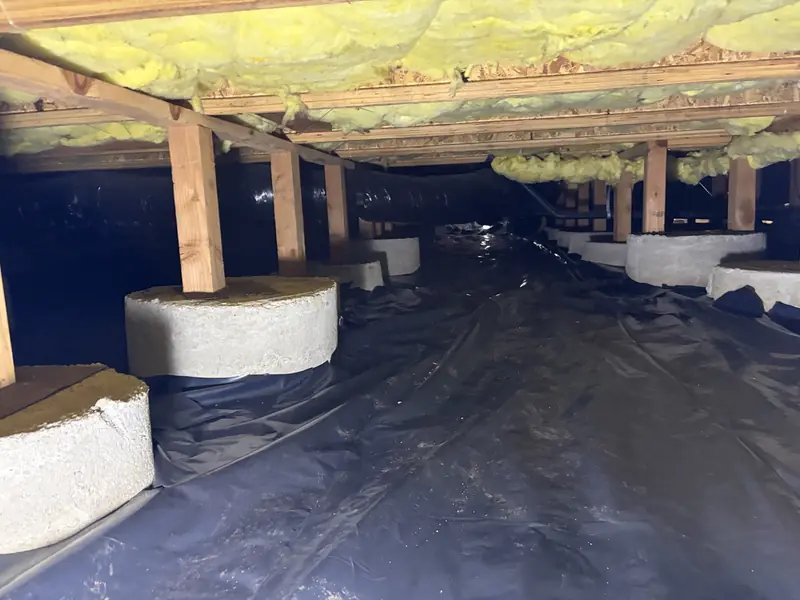
Sloped crawl spaces
Hillside crawl spaces are often damper on the uphill side, where water moving through the slope reaches the foundation. A barrier there needs to be laid so water doesn't get trapped on top. If there's active seepage, drainage along that wall comes first.
Damp corners on sloped lots
On Camas hillside lots, the barrier often looks fine across most of the crawl space but stays damp or has water on top along the uphill wall. That's a sign water is arriving through the slope. Laying new plastic over it won't fix the cause. Drainage along that wall, plus outside changes to reduce water reaching it, usually solves it — and then the barrier stays dry.
The installation
- Remove old plastic and debris
- Cover the soil completely, seams overlapped
- Fit around piers, posts and pipes
- Run to the foundation walls
Going further
Some Camas homeowners choose encapsulation, which seals the liner up the walls and closes the space. It's optional; we'll explain the difference.
What affects the scope in Camas
- Crawl space size and slope
- Shallow uphill areas
- Drainage needs
- Old plastic and debris removal
- Material
A step toward encapsulation
If you think you may encapsulate later, tell us. We can plan the barrier so it fits with a future upgrade.
Questions from Camas homeowners
Why is the uphill side of my crawl space damp?
Water moving through the slope. We'll check whether it needs drainage.
Does a newer Camas home need a new barrier?
If it's been torn or displaced, yes. Otherwise it may be fine.
How do I get an estimate?
Getting started is easy. Call or text (360) 470-4956, or fill out the form on this page. We'll learn what's going on beneath your home, schedule a time to take a look, and give you a straightforward vapor barrier estimate.