
Why it helps
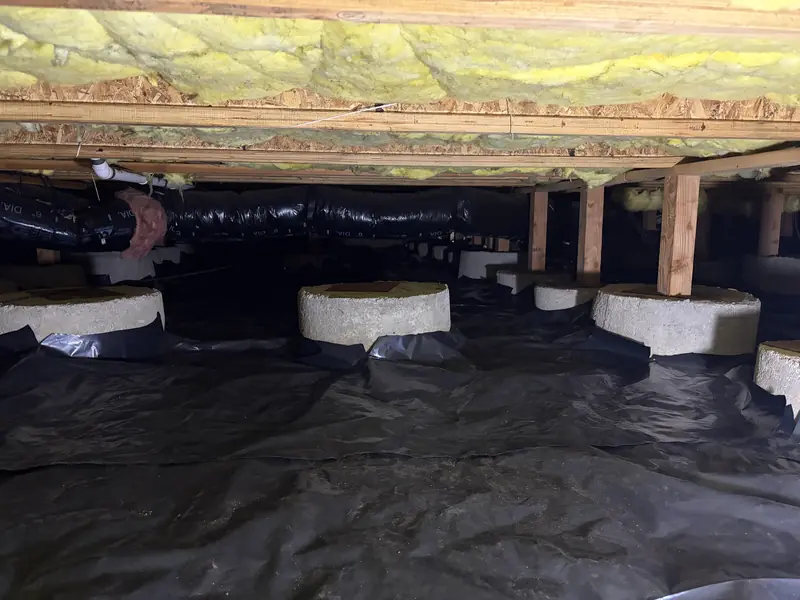
Damp soil under a house raises humidity in the crawl space. That moisture finds its way into insulation and wood. In winter, when cold Gorge air comes through the vents, damp insulation insulates even less. A good barrier reduces moisture at the source.
How a good barrier is laid
A barrier only works if soil isn't left exposed. We start at the walls and work across the crawl space, overlapping each sheet so water vapor can't slip through the seams. Around piers and posts, the plastic is cut and fitted closely rather than left with gaps. At the perimeter, it runs to the foundation wall. Paths where people will crawl — to the furnace, water heater or plumbing — get extra care, since that's where barriers usually tear first. In Washougal homes where we're also replacing insulation, laying the barrier first gives installers a clean surface to work from.
What we install
- Old plastic and debris removed
- Soil fully covered with overlapped seams
- Fitted around piers and pipes, run to the walls
Pair with insulation
If floor insulation is damp or fallen, replacing it alongside the barrier is efficient. See insulation in Washougal.
What affects the cost in Washougal
- Crawl space size
- Old plastic removal
- Obstructions and access
- Material
- Insulation work done at the same time
Barrier and insulation together
Laying a new barrier and replacing insulation in one visit is efficient and leaves the crawl space in good shape for winter.
Questions from Washougal homeowners
Will a barrier make my floors warmer?
Indirectly — drier insulation works better. Insulation itself does the heavy lifting.
Is encapsulation better?
It does more, at more cost. A barrier is often enough.
How do I get an estimate?
Getting started is easy. Call or text (360) 470-4956, or fill out the form on this page. We'll learn what's going on beneath your home, schedule a time to take a look, and give you a straightforward vapor barrier estimate.